ccMonetproduct case

Code computes the facts. AI reasons over them.

ccMonet is an AI accounting platform for small businesses and their accountants. I designed it so models never become the source of truth for computed financial numbers: the platform calculates, the agent interprets and acts, and people retain accountability. Accountants close faster; owners get timely, accurate numbers.

Multi-marketAccounting workflows for SMBs across Singapore, Hong Kong and Malaysia
AI-assistedEvidence-backed bookkeeping preparation with a clear path for human review
Close-readyMore efficient month-end workflows through reviewable records and exceptions
VisibilityMore granular financial information to support business decisions

Anything missing or ambiguous goes to a person.

How I think about AI products

Four decisions in ccMonet

Financial software has a deterministic source of truth. AI sits above it to interpret ambiguity, agents act through constrained tools instead of bypassing the product, and people keep accountability where evidence is incomplete.

Document AI

Automate the preparation, not the accountability.

AI extracts and structures incoming financial documents, from invoices and receipts to bank statements and contact lists. Deterministic checks validate what can be validated. Strong evidence flows forward; incomplete or conflicting evidence becomes an exception for an accountant.

  • Structured validation and accounting checks keep extraction separate from financial decisions.
  • Representative test cases and failure analysis help evaluate the end-to-end workflow, not just model output.
  • Product changes are assessed against known edge cases and the quality of the resulting records.
  • Automation respects the customer’s configured scope and preserves a path to human review.

Value: Less manual bookkeeping preparation, more consistent validation and a clear review path when evidence is missing or ambiguous.
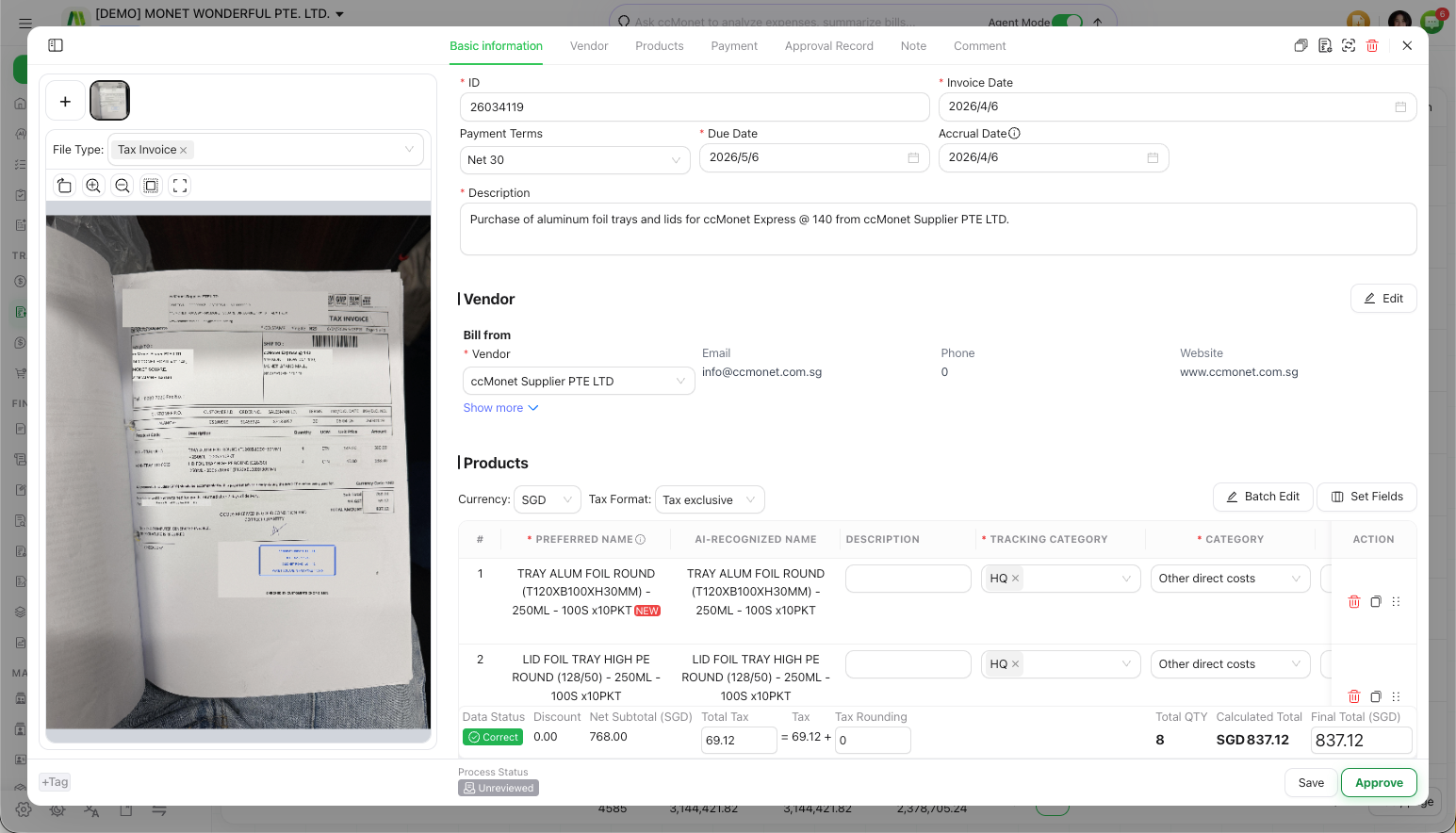
Screenshot from the ccMonet user guide: captured vendor bill with source preview, extracted fields and editable line items
User manual screenshot: Review and edit a captured vendor bill
Vendor bill review: source document alongside editable extracted fields. View user guide ↗

Bank reconciliation

A wrong match is worse than no match.

Rules and a matching algorithm narrow candidates first; AI and the agent resolve what's left from descriptions and documents. Weak evidence becomes an exception, not a guess.

  • Reference, counterparty and amount are explicit evidence.
  • Gaps are typed: FX difference, rounding, bank fee.
  • "No match" is a valid answer.

Value: Evidence-backed routine matches can be resolved sooner, while unsupported transactions remain visible for accountant review.

Illustrative reconciliationFictional examples · No customer data
Bank evidence
System decision
Sample transfer, Merchant A3,000.00
Sample invoice INV-0013,000.00Reference and amount
Card, cloud software (USD)1,342.50
Bill, USD 1,000.00Matched with FX differenceCounterparty and amount
Card, unknown merchant388.00
No supporting documentHeld for reviewNot enough evidence
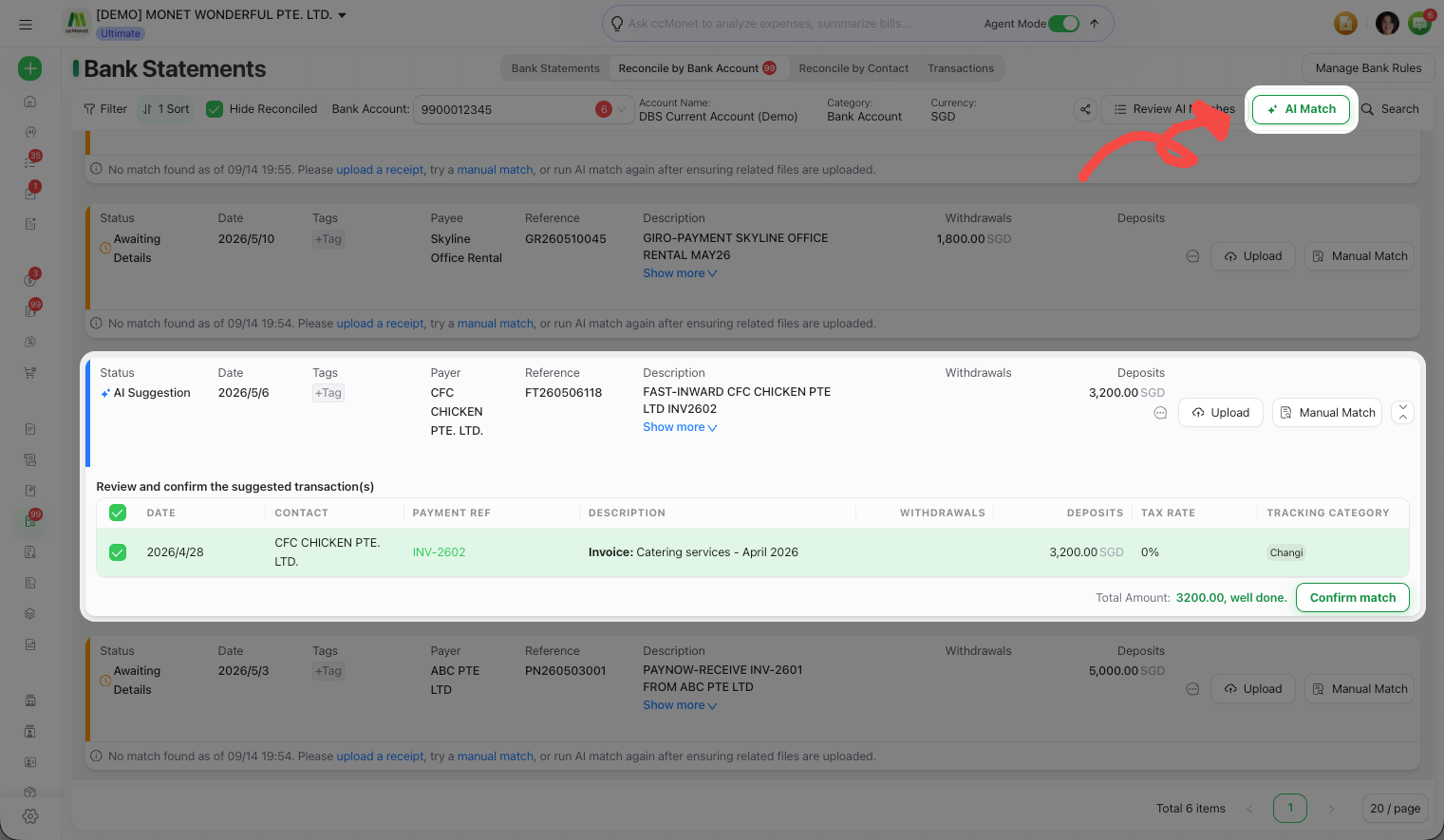
Screenshot from the ccMonet user guide: bank transaction AI Match suggestions with confirmation and rejection actions
User manual screenshot: Confirm or reject an AI Match
AI Match review: confirm the supported matches and reject the wrong ones. View user guide ↗

Agent design

Same system, narrower authority.

Monet is designed to support financial review by surfacing issues with relevant evidence and suggested next steps. Agent actions stay within governed product capabilities, while accounting rules, permissions and consequential approvals remain with the platform and its users.

  • Agent tasks use bounded business capabilities instead of unrestricted actions.
  • Evidence and product validation shape what can be recommended or completed.
  • Important or ambiguous actions require an accountable review path.

Value: Less time gathering routine review evidence, with clearer context for the financial decisions that still require a person.

Bounded agent workflowsIntent, evidence and governed action
Monet or an external agentIntent, reasoning, plan
Product safeguardsScoped actions, evidence and review
Financial product servicesValidated records and accountable approval
Read: authorized contextAssist: review workflowsChanges: validated and accountable

Financial controls

A new kind of operator needs new controls.

Traditional accounting software trusts the authenticated user as the operator. AI needs narrower authority, stronger provenance and reversible actions, so AI drafts are kept apart from the posted books.

  • Approval state decides when a record becomes authoritative.
  • Unmatch and reversal are first-class actions.
  • Exceptions come with a next step, not a model error.

Result: AI-originated changes stay traceable to their source evidence, actor and approval or reconciliation path, so accountants review instead of redo.

AI draft
  • Extracted fields
  • Suggested accounts and matches
  • Agent-prepared entries
Posted books
  • Ledger entries and balances
  • Reconciled bank lines
  • Reports and tax figures
Between them: validation, approval and a recorded actor. Nothing crosses on model confidence alone.

My role

I lead product decisions across document intelligence, reconciliation, agent workflows, financial operations and AI quality, collaborating with engineering and accounting specialists. My focus is the boundary between probabilistic interpretation and reliable financial records.

Product architectureSet the line between code, agent and person, and the agent's read and write scope.
AI evaluationShaped practical quality evaluation with representative cases, regression checks and evidence-led failure analysis.
Accounting workflowsOwned requirements for the ledger, AP/AR, banking, payroll, fixed assets, IFRS 16, multi-currency, quotations and POs, permissions and reports.
Product value and strategyPrioritized finance-team efficiency and more granular financial visibility, connecting product choices to repeatable customer outcomes.

Don't start from what else we could build. Start from who will pay for which result, what data and capability that result needs, and whether we can deliver it reliably and repeat it with what we have.

Take the ideas further.

Use my Design Skill on your product, or connect my read-only portfolio MCP to ask ChatGPT or Claude about my work, experience and design decisions.

Open-source Skill

Use my product decision framework.

Review features, design AI-native workflows, and challenge product direction using my practical design principles.

Get the Design Skill
Live · Read-only

Get to know the person behind the product.

Connect ChatGPT or Claude to explore my experience, ccMonet agent architecture, FastStatement, open-source projects, and why I made each product decision. 59 curated public-safe topics, with sources.

Two ways to explore: use my open-source Skill to improve your product, or connect the live portfolio MCP to ask your AI about my experience and design trade-offs. Public, source-linked and read-only.

Try asking: “What did Tingyu design for ccMonet agents?”  ·  “Why does FastStatement use white-box reporting?”  ·  “Which projects demonstrate his AI product judgment?”

Explore my work in your AI assistant.

Meet the person behind the product decisions. Ask about ccMonet agent design, FastStatement, product philosophy, career experience and open-source projects. This live service returns curated, source-linked summaries—not proprietary code.

Live · Public · Read-only

Claude · Customize → Connectors

Add a custom connector, then paste the remote MCP URL below. Claude supports remote MCP connectors; your workspace may require admin permission.

https://mcp.botly.cc/mcp
Try asking your AI

“How did Tingyu balance agent autonomy with accounting correctness?”

“What are the product decisions behind FastStatement?”

“Which projects demonstrate his AI product leadership and where is the proof?”

This is a public, read-only knowledge MCP: no API key is required by the server. Claude and ChatGPT may restrict custom connector setup based on account or workspace permissions. No access is given to private repositories or company systems.